
Newark NJ Asbestos Laws — What Landlords and Property Managers Must Know
A landlord-focused guide to New Jersey asbestos regulations, Essex County DEP requirements, and what is required before any renovation or demolition work on a Newark rental property.
Quick Answer
Newark NJ landlords with pre-1980 rental properties are subject to NJ Admin Code 12:120, which requires licensed inspectors to survey suspect materials before any renovation that could disturb asbestos-containing materials. Projects disturbing more than 3 linear feet or 3 square feet of ACM require advance NJ DEP notification. All abatement must be performed by a licensed NJ contractor, and documentation must be maintained for each project.
The Regulatory Framework: NJ Admin Code 12:120
Asbestos work in New Jersey is governed primarily by NJ Admin Code 12:120, administered by the NJ Department of Labor and Workforce Development. This regulation establishes the licensing requirements, work practice standards, and documentation requirements that apply to asbestos abatement in the state. If you own rental property in Newark and that property was built before 1980, this regulation is directly relevant to any renovation work you plan.
The core of 12:120 for property owners is straightforward: asbestos-containing materials must be assessed by a licensed inspector before renovation or demolition work that could disturb them, and any abatement must be performed by a licensed contractor using approved work practices. The regulation also establishes air monitoring requirements, disposal standards, and notification requirements for larger projects.
Beyond 12:120, Newark landlords may also be subject to federal EPA regulations for demolition and renovation projects of certain sizes, Essex County DEP requirements, and the Newark municipal code. For most residential renovation projects, 12:120 is the primary compliance focus, but larger projects and demolitions may trigger additional requirements.
What NJ Admin Code 12:120 Requires of Newark Landlords
Asbestos Survey Before Renovation
Before any renovation that could disturb suspect asbestos-containing materials in a pre-1980 building, a licensed NJ asbestos inspector must survey the affected areas. This is not a recommendation, it is a legal requirement. The inspector documents the location, type, condition, and estimated quantity of any asbestos-containing materials in the work area.
The survey results determine what must happen before work proceeds. If no asbestos-containing materials are found in the work area, renovation can proceed. If ACM is identified, it must be addressed by licensed abatement before the renovation contractor touches those areas.
Licensed Contractor Required for All Abatement
No asbestos abatement work in New Jersey can be performed by unlicensed individuals or companies. This applies to every quantity of asbestos-containing material. There is no de minimis exception in New Jersey for renovation work: if a licensed inspector confirms ACM is present in a work area, a licensed contractor must remove or encapsulate it before other trades can work in that area.
Hiring an unlicensed individual to remove asbestos-containing materials is a violation of NJ regulations and exposes you to significant liability. If a tenant or contractor later becomes ill from asbestos exposure, the documentation trail matters enormously. Work performed by a licensed contractor with proper documentation protects you. Work performed without documentation or by an unlicensed party does not.
DEP Notification for Larger Projects
Projects that will disturb more than 3 linear feet or more than 3 square feet of asbestos-containing material require advance notification to the NJ DEP. This notification must be submitted before work begins and includes information about the scope of work, the materials to be disturbed, and the contractor who will perform the abatement. The DEP notification requirement applies to the total ACM disturbed across the project, not per material type.
Most large-scale renovations of pre-1980 Newark buildings will trigger this requirement. If you are planning a gut rehab, full kitchen or bathroom renovation, or multi-unit building rehab, assume the DEP notification threshold will be reached and plan accordingly.
Air Clearance Testing and Documentation
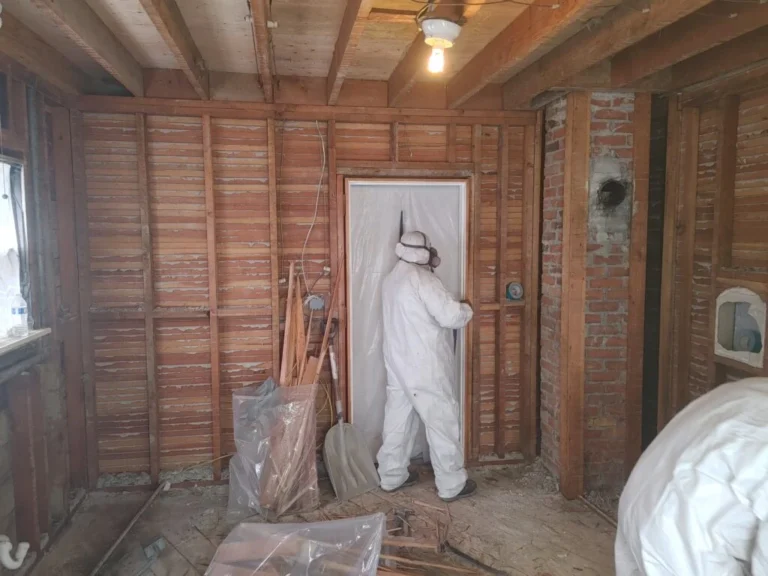
After abatement work is completed, the work area must pass air clearance testing before it can be re-occupied or turned over to other trades. An independent industrial hygienist collects air samples and submits them to an accredited laboratory. Work areas that do not pass clearance require additional decontamination and re-testing before clearance is granted.
All of this documentation, the inspection report, the abatement scope, waste disposal manifests, and the clearance report, must be maintained by the property owner. These records are required by regulation and are critical protection in any future property transaction, insurance claim, or legal matter involving the property.
Practical Landlord Scenarios and What They Require
Unit Turnover Renovation Between Tenants
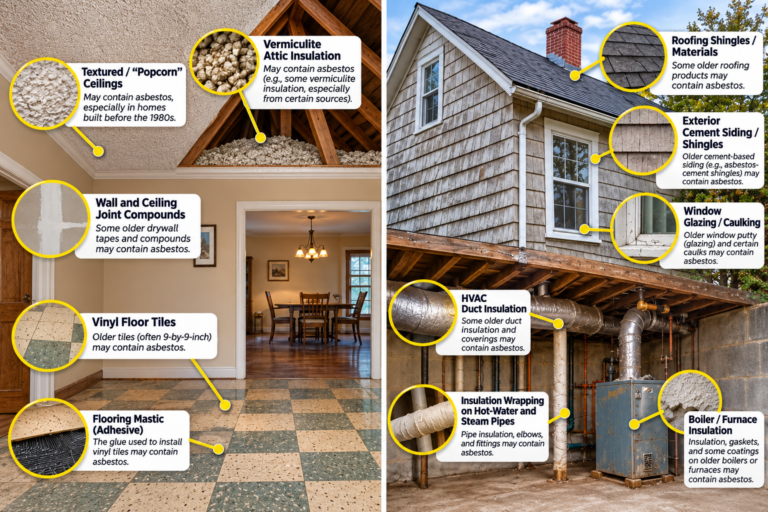
You are renovating a vacant unit in your 1965 Newark two-family between tenants: new flooring, paint, bathroom updates, and kitchen refresh. This is one of the most common situations we handle for Newark landlords. Before any contractor begins floor removal, ceiling work, or kitchen demo, the affected areas must be tested by a licensed inspector. In a 1965 building, the floor tiles and adhesive, ceiling texture, and any pipe-containing walls are all suspect. Testing takes a few hours and results come back within 24 to 72 hours. If ACM is found, abatement must be completed and cleared before the renovation contractor begins. Build this into your timeline.
Building-Wide Boiler or Pipe Work
You are replacing the boiler and reinsulating the steam pipes in a 1950s Newark apartment building. Pipe insulation from this era almost always contains asbestos. Before any mechanical contractor touches the existing insulation, it must be inspected. If asbestos is confirmed, a licensed abatement contractor must remove and dispose of the old insulation before the mechanical contractor can proceed. This is a common sequence for HVAC and plumbing projects in Newark’s older buildings. Plan for it in your contractor sequencing and project timeline.
Emergency Repair: Damaged Pipe Insulation
A tenant reports that the pipe insulation in the basement utility room is visibly deteriorating and falling. This is a more urgent situation because deteriorating asbestos pipe insulation can release fibers passively. The immediate response is to restrict access to the area until a licensed inspector can assess it. Do not attempt to clean up or contain the material yourself. Do not send a handyman or maintenance person into the area without a protective plan. Contact a licensed asbestos inspector for an emergency assessment. Under NJ 12:120, emergency abatement procedures are available for situations involving imminent hazard, which may allow expedited work without the standard advance notification period.
Pre-Sale Asbestos Assessment
You are preparing to sell a Newark multi-unit investment property. While there is no universal NJ requirement to disclose the presence of intact asbestos-containing materials in a property sale, any known ACM is a material fact that a seller should disclose. More importantly, a buyer conducting due diligence will commission an asbestos survey as part of the inspection process. Having a current survey and documentation of any prior abatement work reduces friction in the transaction and protects you from post-closing claims. For more on this topic, see our article on asbestos testing before home sale in Newark NJ.
Operations and Maintenance Plans for Buildings with Known ACM
For multi-unit buildings that have been assessed and contain intact asbestos-containing materials that are not being removed, an Operations and Maintenance (O&M) plan is a best-practice approach that is sometimes required by regulation. An O&M plan documents the location and condition of all known ACM in the building, establishes inspection and monitoring schedules, defines work practices for activities that could disturb the ACM, and provides training requirements for maintenance staff.
For Newark landlords managing older buildings, an O&M plan serves two functions: it keeps the building in compliance and it demonstrates due diligence in the event of any future liability claim. We can help building owners develop O&M plans for their Newark properties as part of our consulting services.
Common Questions
Newark Asbestos Laws for Landlords: FAQ
There is no general NJ requirement that landlords proactively test all older rental properties for asbestos in the absence of renovation or demolition plans. The testing requirement under NJ Admin Code 12:120 is triggered by renovation or demolition work that could disturb suspect materials. However, if you have visible deteriorating insulation or other materials that could be releasing fibers, you have an obligation to address the hazard. And if any renovation is planned, even something as limited as replacing a floor or updating a bathroom, testing is required before that work begins in a pre-1980 building. For buildings where you do not have documentation of prior testing, getting an initial assessment is good practice even without an immediate renovation plan.
Penalties for non-compliance with NJ Admin Code 12:120 include civil fines, stop-work orders, and mandatory remediation at the property owner’s expense. The NJ Department of Labor enforces these regulations and can audit renovation projects. Beyond regulatory penalties, the more significant risk for landlords is civil liability. If a tenant, contractor, or subsequent owner suffers asbestos-related health effects and can trace the exposure to work done on your property without proper abatement documentation, the absence of that documentation is a significant liability exposure. Licensed abatement with proper documentation is not just regulatory compliance, it is the primary protection against that liability.
New Jersey law requires landlords to disclose known environmental hazards that materially affect habitability. Intact, non-deteriorating asbestos-containing materials that are not in areas tenants regularly contact or maintain are generally considered manageable rather than an immediate hazard requiring disclosure. However, deteriorating ACM, ACM in areas tenants will disturb (floor tiles in habitable areas, ceiling texture in occupied spaces), or any ACM that poses a realistic exposure risk should be disclosed. The practical answer for most Newark landlords: consult with a licensed asbestos inspector about the condition and location of any ACM in tenant-occupied spaces and follow their guidance on disclosure and management. We can advise on this as part of a building assessment.
The cost depends entirely on what is found and where. A small floor tile abatement in a single bathroom, perhaps 50 to 60 square feet of VAT, might cost a few hundred to a few thousand dollars. A building-wide pipe insulation abatement in a large multi-unit building could be significantly more. The honest answer is that there is no useful general estimate without knowing what is present and how much needs to be addressed. What we consistently tell Newark landlords is: budget for the possibility when planning renovation projects in pre-1980 buildings, get the inspection done before you lock in your renovation contractor’s schedule, and factor the potential abatement cost into your project contingency. Discovering ACM mid-renovation with the renovation contractor already on-site and on a schedule is the expensive version of this problem. Call us at (973) 561-2655 for a free assessment before your next renovation project.
4 Comments