
Asbestos Testing Before Selling Your Newark NJ Home — What Buyers and Sellers Need to Know
For pre-1980 Newark properties, asbestos testing before listing can prevent deal disruptions, protect against post-closing claims, and give both buyers and sellers a clear picture of what they are working with.
Quick Answer
New Jersey does not universally require asbestos testing before a home sale, but sellers of pre-1980 Newark properties are required to disclose known material defects, and asbestos-containing materials in deteriorating condition qualify. Buyers conducting due diligence on older Newark properties routinely commission asbestos surveys during the inspection period. Proactive seller testing typically costs less than 3 to 5 business days of delay and reduces deal disruption risk significantly.
The Legal Landscape: What NJ Requires for Home Sales
New Jersey does not have a universal requirement that sellers test for asbestos before listing a residential property. However, New Jersey’s seller disclosure law requires sellers to disclose known material defects that affect the value or habitability of the property. Known asbestos-containing materials that are in deteriorating condition, that pose a realistic exposure risk, or that are in areas tenants or occupants regularly use or maintain, could qualify as material defects requiring disclosure.
The word “known” is important here. A seller who has never had their pre-1980 Newark home tested for asbestos does not know whether it contains asbestos and is not required to disclose speculation. However, a seller who has had the property tested and knows the results has an obligation to disclose positive findings in circumstances where the finding is material. If you have tested the property before listing, the results are part of your disclosure obligations.
This is one reason some sellers prefer not to test proactively, but this reasoning has significant risks. Buyers conducting due diligence may commission their own asbestos survey during the inspection period, which could result in a renegotiation, a buyer-demanded credit, or a deal falling through late in the process. Proactive testing by the seller before listing gives the seller more control over the narrative and the timing.
Why Sellers of Newark Pre-1980 Homes Should Consider Pre-Listing Testing
Control the Process Before Inspection
When a buyer’s inspector orders an asbestos survey during the inspection contingency period, the results arrive on the buyer’s timeline and are immediately reported to the buyer. If the results show positive ACM, the buyer is in the driver’s seat on negotiation: they can demand a credit, demand abatement before closing, or walk away. The seller has no preparation time and no ability to manage the situation proactively.
If the seller has tested before listing and knows what is there, they have 3 options: address the issue before listing (abate the ACM), price the property reflecting the known condition, or disclose the condition with a clear written disclosure and documentation. All three put the seller in a stronger negotiating position than being surprised during due diligence.
Avoid Late-Stage Deal Disruption
An asbestos finding during the inspection period, especially if it is something significant like deteriorating pipe insulation throughout a basement mechanical system, can lead to a buyer walking away from a deal that is otherwise well along. For Newark sellers who have already begun their own purchase process, a collapsed deal creates a cascade of problems. Proactive testing before listing eliminates this specific risk.
Protect Against Post-Closing Claims
A seller who conceals a known material defect is exposed to post-closing liability for fraud or misrepresentation. In the asbestos context, if a buyer later has the property tested (perhaps because they are planning a renovation), discovers ACM that a seller knew about and did not disclose, and can demonstrate that the seller had knowledge, the seller faces potential liability. Proactive testing and proper disclosure, with documentation, provides far stronger protection than a strategy of not looking.
What Buyers of Newark Pre-1980 Properties Should Do
Include Asbestos Survey in Your Inspection Contingency
When writing an offer on a pre-1980 Newark property, make sure your inspection contingency is broad enough to include an asbestos survey in addition to the standard home inspection. Many buyers assume a home inspection covers asbestos, but a standard home inspector is not a licensed asbestos inspector and cannot provide definitive asbestos results. An asbestos survey requires a licensed NJ inspector who collects and submits samples for laboratory analysis.
Build enough time into your inspection contingency for asbestos survey results to come back: at minimum 7 to 10 business days is advisable for properties with multiple suspect material categories.
Understand What Positive Results Mean
If an asbestos survey of a Newark property you are considering purchasing returns positive results for one or more materials, it is not automatically a deal-killer. Intact, non-deteriorating ACM that is not in areas that will be disturbed is a manageable condition. Many Newark properties change hands with known ACM that the buyer and seller have agreed to address appropriately. What positive results mean is that you need to factor the cost and requirements of managing or abating that material into your understanding of the property’s true cost.
Work with your licensed asbestos contractor to understand the scope and cost implications of what was found before you finalize your negotiation position.
Get Documentation as Part of the Transaction
Whether the seller has tested before listing or you are commissioning the survey during due diligence, make sure that the complete documentation package transfers to you as the buyer at closing: the inspection report, laboratory results for all samples tested, any prior abatement documentation for work already done, and any O&M plan if one exists for the property. These documents are valuable in future property transactions and critical if you ever undertake renovation work on the property.
The Estate Sale and Inherited Property Situation
Estates selling inherited Newark properties are in a somewhat different position. An executor may have no personal knowledge of the property’s asbestos history, and the original owners may have no records of testing or abatement done decades ago. In this context, commissioning a fresh asbestos survey before listing is good practice: it gives the estate documentation of the property’s current condition, reduces the risk of post-closing claims against the estate, and allows an accurate assessment of what the property needs before or after sale.
Common Questions
Asbestos Testing Before Newark NJ Home Sale: FAQ
Asbestos in a Newark home does not automatically prevent a mortgage approval or derail a sale, but the specifics matter. Intact, non-deteriorating asbestos-containing materials in areas that will not be disturbed are generally not a deal-killer for most buyers or lenders. Deteriorating ACM that poses an active exposure risk, or significant pipe and boiler insulation abatement needs, can affect buyer negotiation positions and may trigger lender requirements for remediation before closing depending on the loan type. FHA and VA loans have specific habitability requirements that deteriorating ACM can trigger. Conventional loans have more flexibility. If the property has significant asbestos issues, abating them before listing tends to produce cleaner transactions than trying to negotiate through them mid-deal.
A 2008 asbestos report documents the condition of the property at that time and may be useful context. But it should not replace current testing for several reasons. First, the condition of asbestos-containing materials changes over time, especially friable materials like pipe insulation that may have deteriorated significantly in 18 years. Second, the 2008 inspection may not have covered every area of the property or every material type. Third, you have no way to verify from the old report whether any abatement was done between 2008 and today, or whether new suspect materials were installed or uncovered during renovation work. For a pre-1980 Newark property, commission your own survey during your inspection contingency period rather than relying on a report you did not commission and cannot verify.
If asbestos is found during your inspection period, start with a licensed abatement estimate for the specific materials found. The estimate gives you a documented cost basis for any credit or price reduction request. Present the inspection report and the estimate together when requesting a credit. Sellers respond better to documented, specific requests backed by professional estimates than to general requests for a reduction based on asbestos concerns. Focus on materials that require remediation before occupation or before any planned renovation, not every square foot of ACM in the building. A buyer who identifies the real remediation costs and requests a credit proportional to those costs is in a stronger position than one who demands a large reduction without documentation.
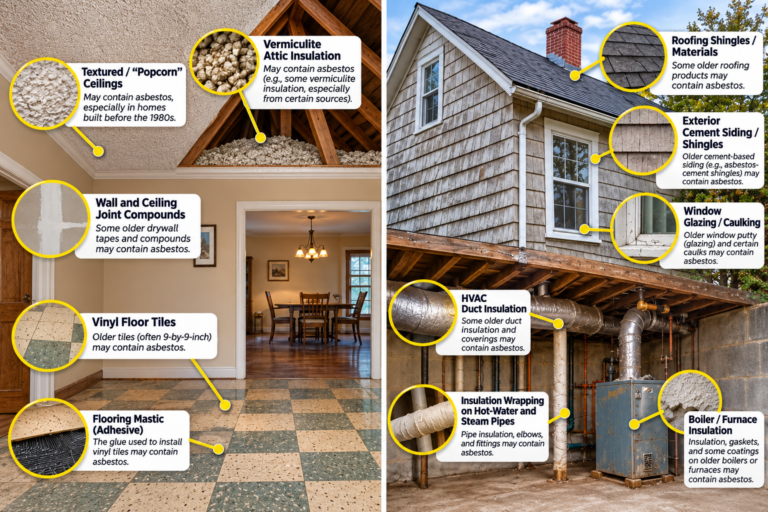
Pre-sale asbestos testing for a Newark single-family or two-family home typically covers the most common suspect material categories: floor tiles and adhesive, pipe and boiler insulation, ceiling texture, and possibly drywall joint compound. The cost varies based on the number of samples collected and the size of the property, but most residential pre-sale surveys fall in the low-to-mid hundreds of dollars range. This is a small cost relative to the value of the documentation it produces and the risk it mitigates in a property transaction. Newark Asbestos Removal offers free initial assessments for Newark and Essex County properties. Call us at (973) 561-2655 to discuss your pre-sale testing needs.
One Comment