
How to Identify Asbestos in Your Newark NJ Home — Signs and What to Do Next
You cannot identify asbestos by looking at it. But you can identify the material types and conditions that make asbestos likely, and you can recognize the warning signs that call for professional testing. This guide covers both.
Quick Answer
You cannot visually identify asbestos in your Newark NJ home — it requires laboratory analysis of a collected sample. What you can do is identify the materials most likely to contain it: floor tiles and mastic installed before 1980, pipe and boiler insulation, popcorn ceiling texture in pre-1978 homes, and drywall joint compound in pre-1977 construction. If any of these are present in deteriorating condition or face disturbance, professional testing is the required next step.
The Fundamental Limitation: Asbestos Cannot Be Seen
The most important thing to understand about identifying asbestos is that you cannot do it visually. Asbestos fibers are microscopic, and the materials that contain them look identical to the same materials without asbestos. Vinyl floor tiles with asbestos look exactly like vinyl floor tiles without asbestos. Asbestos-containing joint compound is visually indistinguishable from non-asbestos joint compound. Asbestos pipe insulation can look like any other pipe insulation.
This is why laboratory testing is the only reliable way to confirm whether asbestos is present. Polarized Light Microscopy (PLM) testing of a collected sample, performed by an accredited laboratory, is the standard method. Everything else is risk assessment based on material type, age, and condition, not identification.
What this guide covers is how to assess which materials in your Newark home are most likely to contain asbestos, and which conditions call for professional testing. The professional confirmation step cannot be skipped.
Materials Most Likely to Contain Asbestos in Newark Homes
Vinyl Floor Tiles and Black Mastic Adhesive
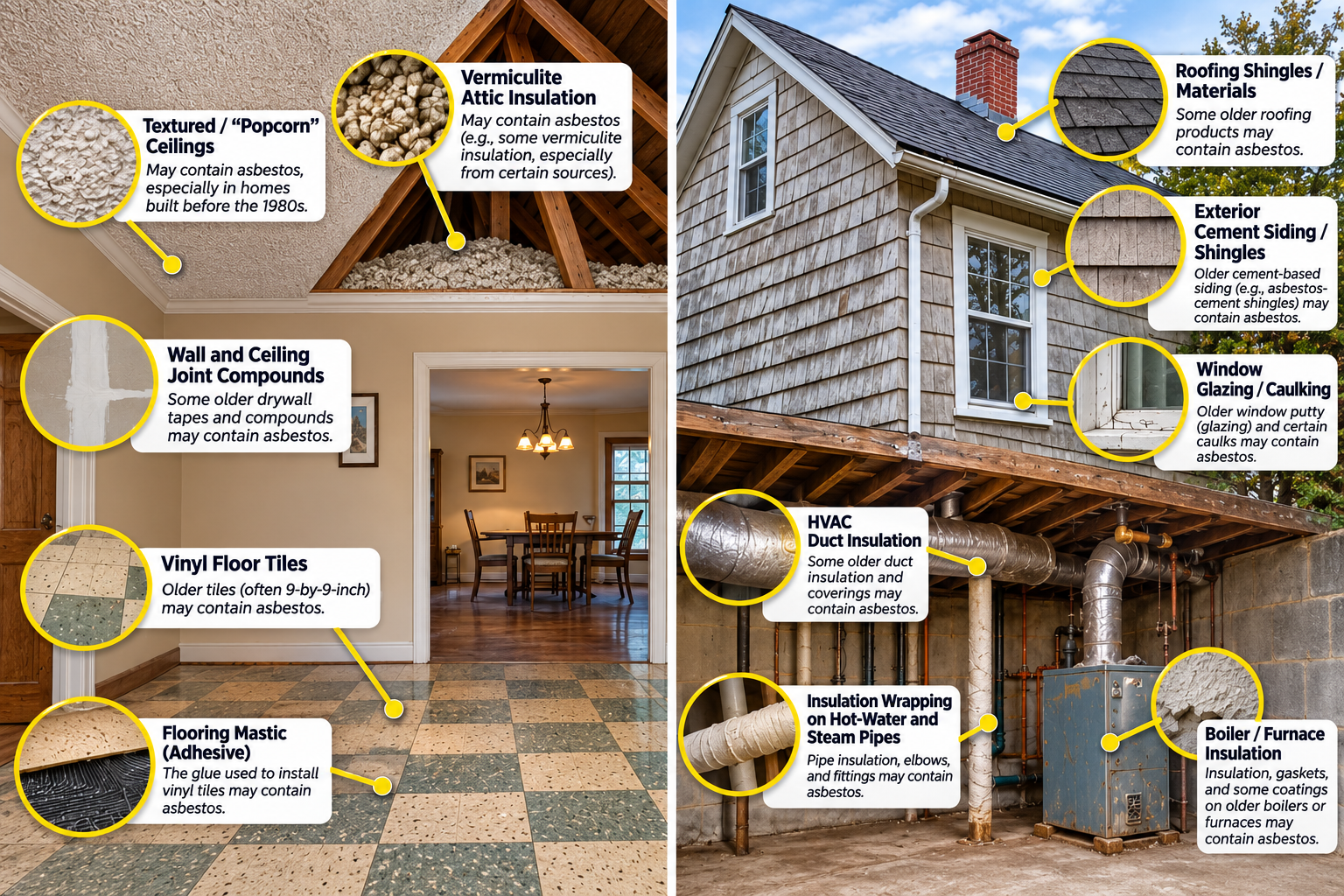
Nine-inch and twelve-inch vinyl floor tiles manufactured before 1980 are among the most commonly asbestos-positive materials we test in Newark homes. These tiles were installed throughout homes in every room type from approximately the 1950s through the 1970s. The most common colors were off-white, beige, tan, gray, and black, though they came in many colors and patterns.
The black adhesive used to install these tiles (called mastic) often contains asbestos independently of whether the tiles themselves test positive. If you find old floor tiles being removed or disturbed, assume both the tile and the adhesive may contain asbestos until laboratory results say otherwise.
Pipe and Boiler Insulation
In Newark homes with steam heating or older hot-water systems, the insulation covering the boiler and the pipes running through the basement and utility areas is a high-probability asbestos location. The most common forms are corrugated cardboard-like paper wrap on straight pipe runs, pre-formed insulating sections on elbows and fittings, and block insulation around the boiler body itself.
Warning signs that asbestos pipe insulation may be releasing fibers: visible crumbling or flaking, white or gray dust on surfaces below the insulation, or insulation that falls apart when touched. Do not touch deteriorating pipe insulation. Restrict access to the area and call a licensed inspector.
Popcorn Ceiling Texture
Spray-applied acoustic ceiling texture, commonly called popcorn ceiling or cottage cheese ceiling, was applied in millions of American homes from the 1950s through the late 1970s. Federal regulations effectively prohibited asbestos in these products by 1978, but products manufactured before the ban contain asbestos in significant percentages. Newark homes from this era with intact original ceilings are likely to have this material.
Popcorn ceiling that is in good condition and not being disturbed is generally not a significant daily hazard. The concern is renovation: any project that involves scraping, sanding, or removing this texture in a pre-1978 home requires testing first.
Drywall Joint Compound
Asbestos was added to some drywall joint compounds manufactured before 1977. This is a less visible and often overlooked source of asbestos, because the compound is typically covered by paint and is not an obvious suspect the way pipe insulation or floor tiles are. Any sanding of drywall in a pre-1977 Newark home, whether for repair or renovation, should be preceded by testing if the work will be extensive.
Roof and Siding Materials
Some asphalt roofing products, corrugated cement sheets, and fiber cement siding products manufactured before 1980 contain asbestos. These materials are generally not a concern when intact and maintained, but tear-off, demolition, or significant repair triggers the testing requirement. If your Newark home has original pre-1980 roofing or siding that will be disturbed by upcoming work, include it in your pre-renovation inspection.
Visual Warning Signs That Call for Testing
While you cannot identify asbestos visually, you can identify the following conditions that indicate a need for professional assessment.
Deteriorating Pipe or Boiler Insulation
Visible flaking, crumbling, or falling insulation on pipes or a boiler in a pre-1980 Newark home is the most urgent situation. Do not disturb the material further. Restrict access to the area. Call a licensed inspector for an assessment and, if positive, emergency abatement consultation.
Floor Tiles That Are Damaged, Cracked, or Being Removed
Old floor tiles in a pre-1980 Newark home that are cracked, lifting, or being removed for renovation purposes should be treated as suspect until tested. The same applies to the adhesive below old tile.
Ceiling Texture That Is Flaking or Being Disturbed
Original popcorn ceiling in a pre-1978 Newark home that is peeling, flaking, or being scraped or sanded requires testing before any further disturbance. If the ceiling is in good condition and not being disturbed, routine monitoring and maintenance is usually sufficient.
Gray or Fibrous Dust in Mechanical Spaces
Dust in basement mechanical rooms below deteriorating insulation is sometimes visibly fibrous. This is a warning sign that should prompt immediate professional assessment. Do not attempt to clean it up without professional guidance on the appropriate protective measures.
What to Do When You Suspect Asbestos
If you have identified a material in your Newark home that you believe may contain asbestos based on age and material type, the next step is clear: do not disturb it further, and contact a licensed inspector for a professional assessment.
What not to do:
- Do not sand, scrape, or drill into the suspect material
- Do not break up or remove old floor tiles without testing first
- Do not sweep or vacuum debris from areas with suspected asbestos (standard vacuums spread fibers)
- Do not attempt to collect a sample yourself without proper protective equipment and sample handling procedures
- Do not hire a contractor to do renovation work in the affected area until testing is complete and any necessary abatement is done
What to do:
- Restrict access to any area with deteriorating suspect materials
- Contact a licensed NJ asbestos inspector for a professional assessment
- Get written laboratory results before planning any renovation in the affected area
- If abatement is needed, hire only a licensed NJ asbestos contractor
For more information on the testing process, see our asbestos testing Newark NJ page. To understand what happens after testing, see our page on asbestos removal Newark NJ.
Common Questions
Identifying Asbestos in Newark NJ: FAQ
It depends on the scope and documentation of the renovation. A full gut renovation that removed all original materials and replaced them with new construction after 1980 would have eliminated the original asbestos-containing materials. However, if the renovation was cosmetic (new finishes over original materials), or if the renovation was done in stages with some original elements remaining, asbestos-containing materials may still be present. Without documentation of asbestos testing from prior renovation work, the safest approach for any new renovation is to treat the building as suspect until tested. Many renovation projects over the past few decades were done without proper asbestos testing. Just because the building has been renovated does not mean it was done in compliance with NJ requirements at the time.
Stop work immediately in that area. Do not continue disturbing the tile or the adhesive below it until testing is completed. Old floor tiles found under new flooring are extremely common in Newark’s pre-1980 housing stock, where multiple generations of flooring were installed over each other. If the tiles are 9-inch or 12-inch squares, if they are black, beige, or gray, or if the adhesive below them is black, treat them as suspect until laboratory results say otherwise. Contact a licensed NJ asbestos inspector the same day if possible. Testing can usually be scheduled within 24 to 48 hours, and results come back within another 24 to 72 hours. That is a relatively small delay compared to the risk and liability of proceeding without testing.
DIY asbestos test kits provide instructions for collecting a small sample for laboratory submission. If you choose to collect a sample yourself, the key precautions are: use a respirator rated for asbestos (P100 or N100), wear gloves and dispose of them after, wet the material with water before disturbing it to reduce fiber release, collect only a small sample (a pea-sized amount is sufficient), seal the sample in multiple bags, and clean the sampling area thoroughly. However, for any renovation or compliance purpose, self-collected samples do not satisfy the NJ requirement for a licensed inspector to conduct the survey. Professional testing by a licensed inspector is required for regulatory compliance and for documentation purposes in any renovation project or property transaction.
Professional asbestos inspections in Newark NJ typically range from a few hundred to several hundred dollars depending on the scope of the assessment, the number of samples collected, and the size of the property. A single-family home pre-renovation inspection for a specific renovation area costs less than a full building assessment of a multi-unit property. At Newark Asbestos Removal, we offer free initial assessments for Newark and Essex County properties. During the assessment, we evaluate the suspect materials, recommend which samples to collect, and provide transparent pricing for the laboratory analysis. Call us at (973) 561-2655 to schedule your free assessment.
3 Comments